Adaptation of Figure 3.2
Varieties of Groups in Plural Societies
Week 6
Acculturation
Soci—231
Response Memo Deadline
Memos for Week 6 are due by 8:00 PM tonight.
Unless …
Click to Expand Invitation
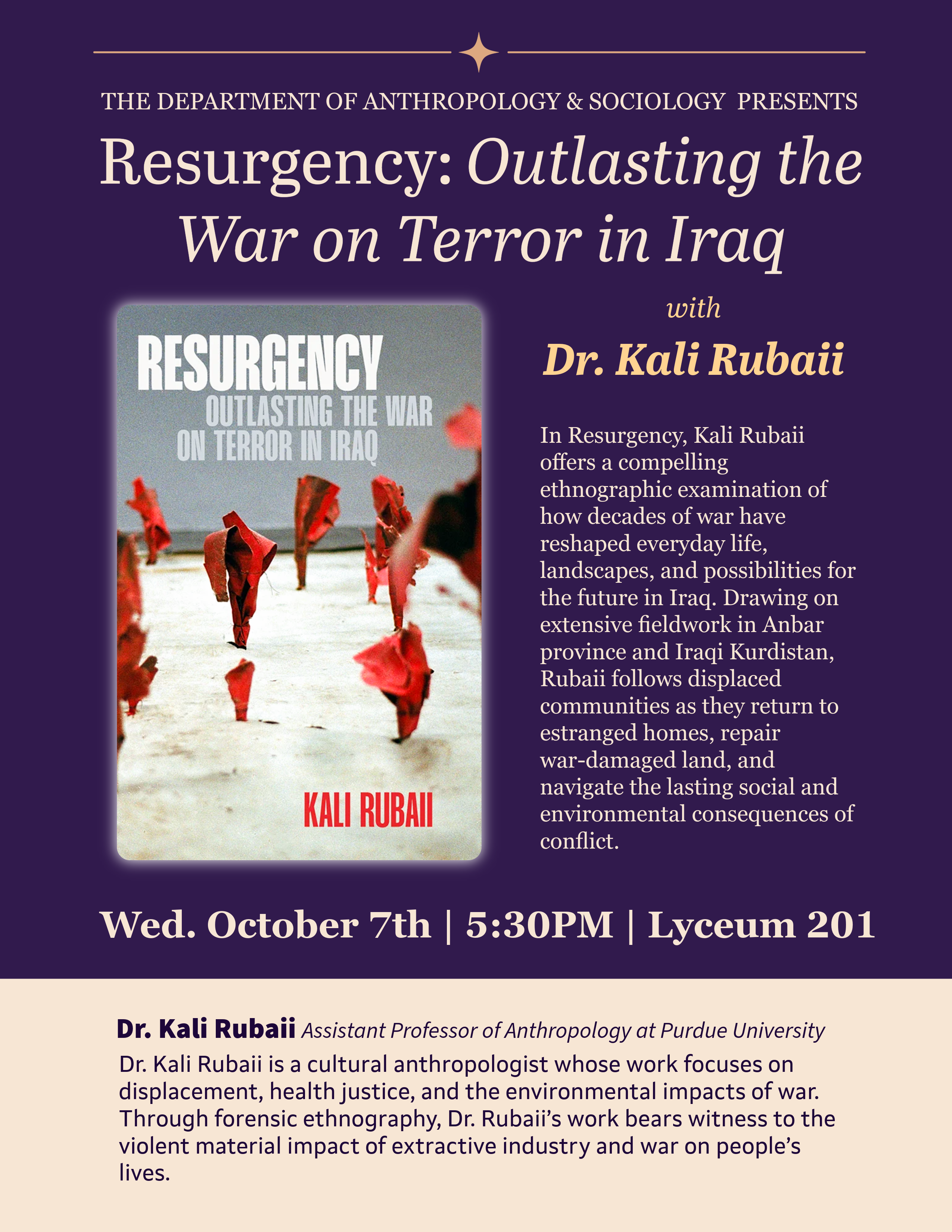
If you attend the lecture, you do not have to submit a response memo tonight.
Until the 2026 U.S. Midterm Elections
Election Day — Tuesday, November 3rd
Click to Expand .gif
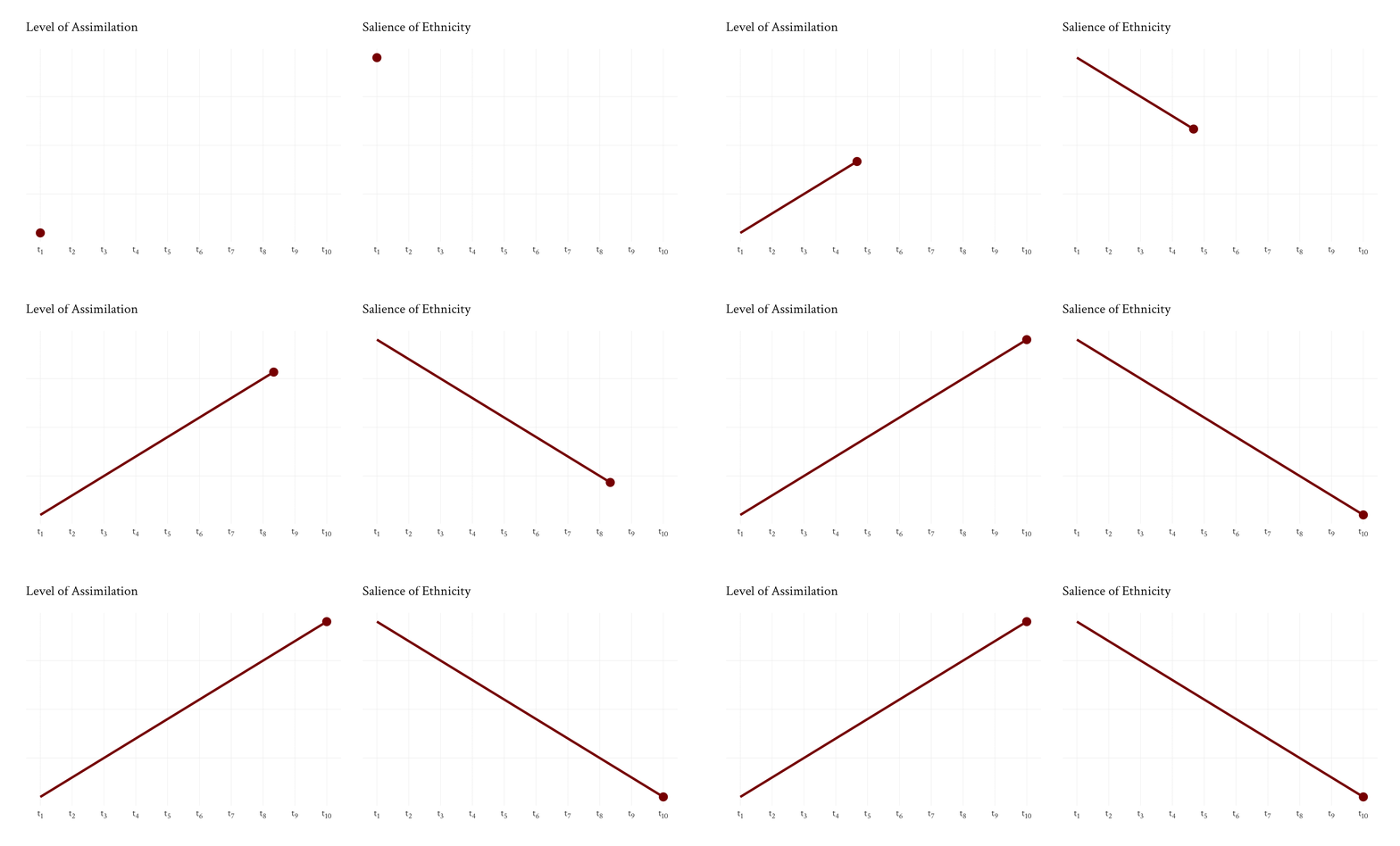
Click to Expand .gif
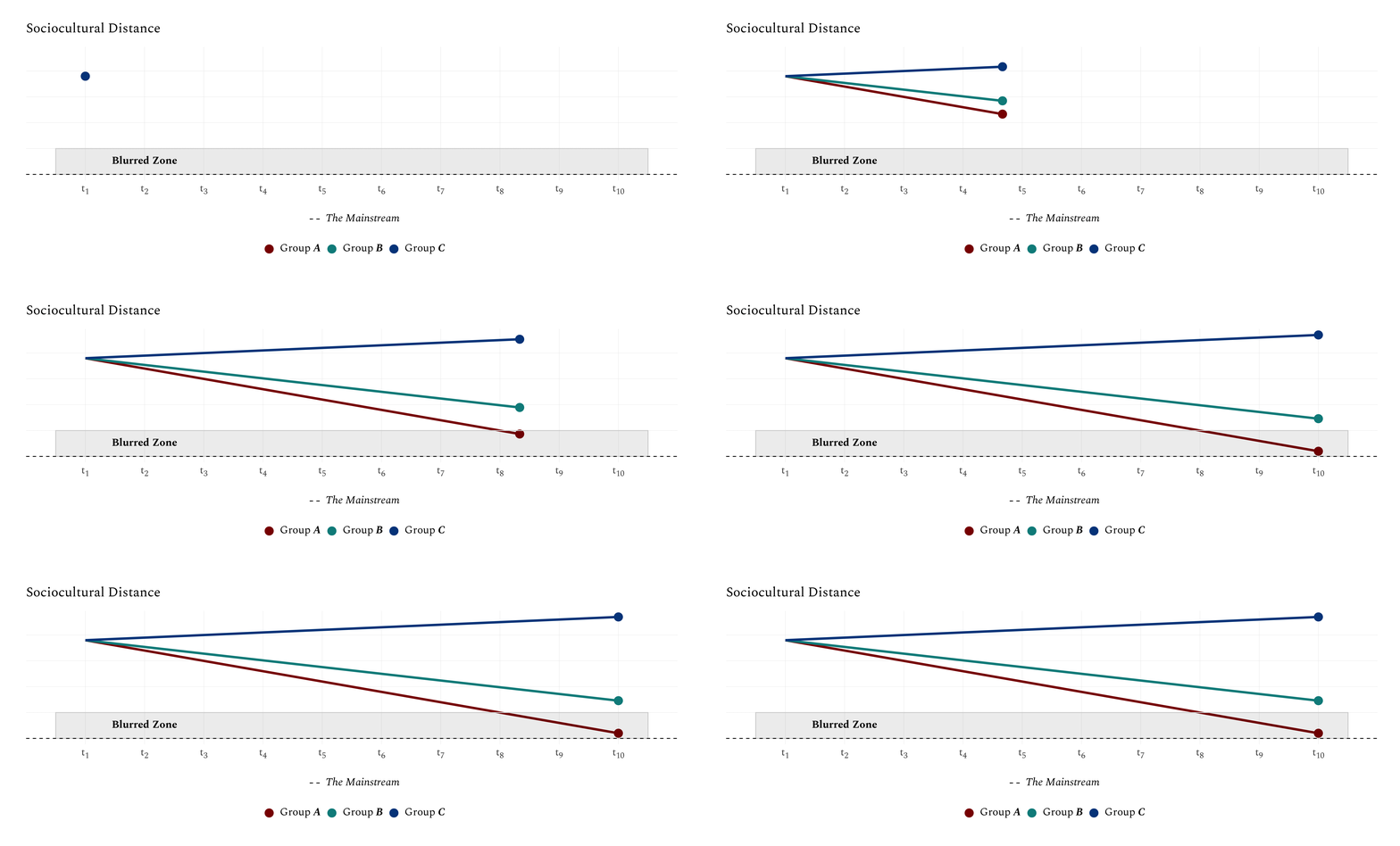
Click to Expand .gif
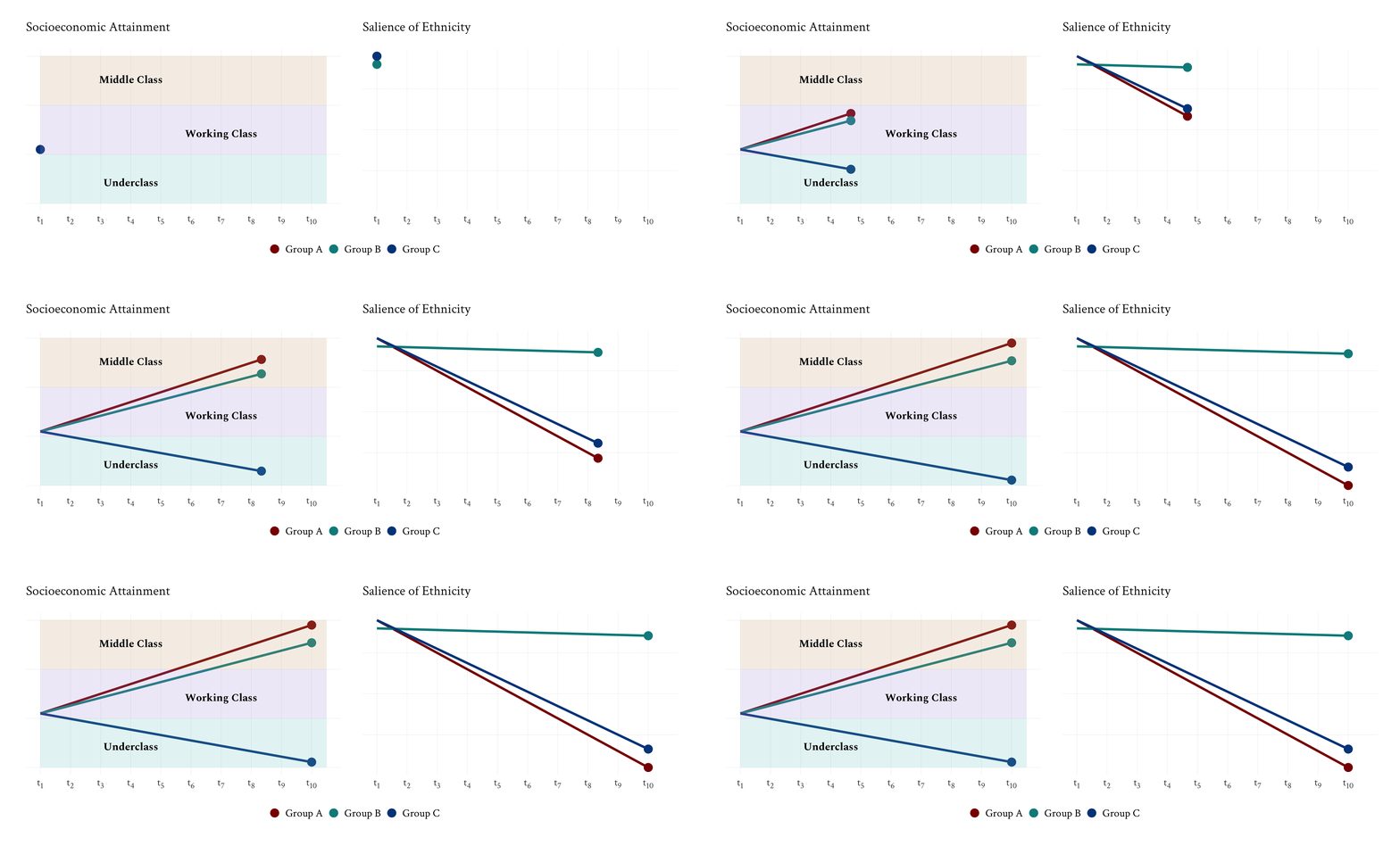
An adaption of Figure 2.1 in Berry (2017).
How have the scholars we’ve engaged with thus far defined—or discussed—acculturation?
Adapted from Table 5 in Gordon (1964)
Adaptation of Table 3.2 from Portes and Rumbaut (2001)
Associated with acculturation are culturally codified notions of appropriate behavior which, when learned, serve as cues to others as to an individual’s level of cultural and social competence. Such competence contributes to reducing social distance by signaling behavioral attributes that appear familiar and trustworthy.
(Alba and Nee 2003:42, EMPHASIS ADDED)
In small groups, discuss the following questions:
How do Park (1914) or Gordon (1964) make sense of acculturation in their theoretical statements?
How about Alba and Nee (2003)?
And finally, how about those championing segmented assimilation theory (Portes and Rumbaut 2001; Portes and Zhou 1993)?
So, why are we returning to acculturation ?
It offers new opportunities.
A look at how non-sociologists—in this case, psychologists—make sense of immigrant incorporation in the modern world.
An entrypoint for theorizing the individual-level adaptation strategies of immigrant-origin people.
Acculturation comprehends those phenomena which result when groups of individuals having different cultures come into continuous first-hand contact, with subsequent changes in the original cultural patterns of either or both groups.
(Redfield, Linton, and Herskovits 1936:149, EMPHASIS ADDED)
According to Redfield and colleagues (1936), analyzing acculturative change involves scrutinizing the following factors:
Types of Contacts (e.g., group size, level of hostility)
Situational Factors (e.g., political inequality, or equality, across groups)
The Process (e.g., selection, sequencing and integration of cultural traits)
Psychological Mechanisms (personality types, psychic conflicts etc.)
Acculturative Results (e.g., acceptance, adaptation or reaction)
Acculturation is, arguably, one of the most frequently mentioned constructs or concepts in ethnic psychology. Indeed, researchers often include some measure of acculturation in their research to analyze differences within ethnic groups and to understand the relationship of acculturation to psychosocial adjustment and health.
(Organista, Marín, and Chun 2010:100, EMPHASIS ADDED)
Psychologists often study how acculturation is related to …
Adaptability to New Situations
Depression and Psychosocial Adjustment
Cigarette Smoking
Alcohol Use
Etc.
[A] dynamic and multidimensional process of adaptation that occurs when distinct cultures come into sustained contact. It involves different degrees and instances of culture learning and maintenance that are contingent upon individual, group, and environmental factors. Acculturation is dynamic because it is a continuous and fluctuating process and it is multidimensional because it transpires across numerous indices of psychosocial functioning and can result in multiple adaptation outcomes.
(Organista et al. 2010:105, EMPHASIS ADDED)
In your small groups, discuss the psychological implications of acculturation (or assimilation more generally).
Graves (1967) introduced the concept of psychological acculturation. This concept refers to changes in an individual who is a participant in a culture-contact situation, being influenced both directly by the external culture and by the changing culture of which the individual is a member. At this individual level, the kinds of changes taking place might be in identity, values, attitudes, and behavior. It is clear that both the cultural and psychological levels of acculturation need to be studied in any comprehensive examination of how groups and individuals change following intercultural contact.
(Berry 2017:16, EMPHASIS ADDED)
What does Berry (2017) mean by the
cultural level of acculturation?
According to Berry (2017), analysts need to be attuned to a few “cultural” or contextual variables at the aggregate level:
Cultural Attributes Prior to Contact
The Nature of Intergroup Contact
Adaptation of Figure 3.2 in Berry (2006)
Can we complicate these classifications?
Why are “group” differences important to account for (i.e., when theorizing acculturative change)?
Analysts also need to be attuned to a few individual-level factors that are endogenous to the acculturation process (cf. Berry 2017):
Psychological Acculturation
Eventual Adaptation
These psychological changes are the what component of individual acculturative changes; they can be a set of rather easily accomplished behavioral changes or they can be more challenging, even problematic. In the former category are surface changes in individuals, for example in their dress, food habits, and language knowledge and use. In the latter category are deeper changes, such as in their cultural identities, cultural values, and even personalities. Second, in problematic cases, the result may be an increase in acculturative stress as manifested by uncertainty, anxiety, and depression … Third, because not everyone seeks to acculturate in the same way, it is important to conceptualize differing ways of acculturating, often termed acculturation strategies.
(Berry 2017:20, EMPHASIS ADDED)
These psychological processes are linked to three long-term adaptations to cultural contact or interpenetration:
Psychological (i.e., self-esteem)
Socicultural (e.g., educational attainment)
Intercultural (e.g., lack of prejudice)
An adaption of Figure 2.1 in Berry (2017).
Mid-Semester Break
The mid-semester break is upon us. Ergo, we do not have class on Tuesday.
Please, do not show up on Tuesday.
Until the 2026 U.S. Midterm Elections
Election Day — Tuesday, November 3rd
What does psychological acculturation refer to?
“[T]he concept of acculturation strategies … refers to
the how of acculturation.”
(Berry 2017:21, EMPHASIS ADDED)
Acculturation strategies consist of two components: attitudes and behaviors (that is, the preferences for, and actual practices of, ways of relating to one’s own and other groups) that are exhibited in day-to-day intercultural encounters.
(Berry 2017:21, EMPHASIS ADDED)
Of course, there is rarely a one-to-one match between what an individual prefers and seeks (attitudes) and what one is actually able to do (behaviors). This discrepancy is widely studied in social psychology and is usually explained as being the result of social constraints on behaviors (such as norms, opportunities, etc.). In this case, these constraints lie in the social and intercultural contexts in which an individual lives, often due to differential power available to groups to pursue their preferred way of acculturating. Nevertheless, there is often a positive correlation between acculturation attitudes and actual behaviors, permitting the use of an overall assessment of individual acculturation strategies.
(Berry 2017:21, EMPHASIS ADDED)
An adaption of Figure 2.1 in Berry (2017).
At the cultural level, as noted previously, the two groups in contact (whether dominant or nondominant) usually have some notion about what they are attempting to do (e.g., colonial policies, or motivations for migration), or what is being done to them during the contact. Similarly, the social, cultural, and political goals of the emergent ethnocultural groups will influence their acculturation strategies; how should we try to live in this new society?
(Berry 2017:21, EMPHASIS ADDED)
At the individual level, both the behavioral changes and acculturative stress phenomena are now known to be a function, at least to some extent, of what people try to do during their acculturation; and the longer-term outcomes (psychological, sociocultural, and intercultural adaptations) usually have some correspondence with the strategic goals set by the groups of which they are members.
(Berry 2017:21, EMPHASIS ADDED)
[T]he original definitions of acculturation foresaw that cultural and psychological homogenization (later identified as globalization) would not be the only possible or inevitable outcome of intercultural contact. This is because people hold different views about how they want to live following contact: Not everyone seeks out such contact, and even among those who do, not everyone seeks to change their culture and behavior to be more like the other (often dominant) group.
(Berry 2017:21, EMPHASIS ADDED)
About 90 years ago, Redfield et al. (1936) specified that assimilation is not the only option available to individuals in the midst of
“intercultural contact.”
Taking this assertion as a starting point, Berry … first distinguished between the strategies of assimilation and integration, and later between these original strategies and separation and marginalization as various ways in which acculturation (both of groups and of individuals) could take place. These distinctions are based on peoples and groups’ orientation to two dimensions: toward one’s own group, and toward other groups in the larger society. A third issue included in the framework was the power of individuals and groups to choose and pursue these two orientations.
(Berry 2017:21, EMPHASIS ADDED)
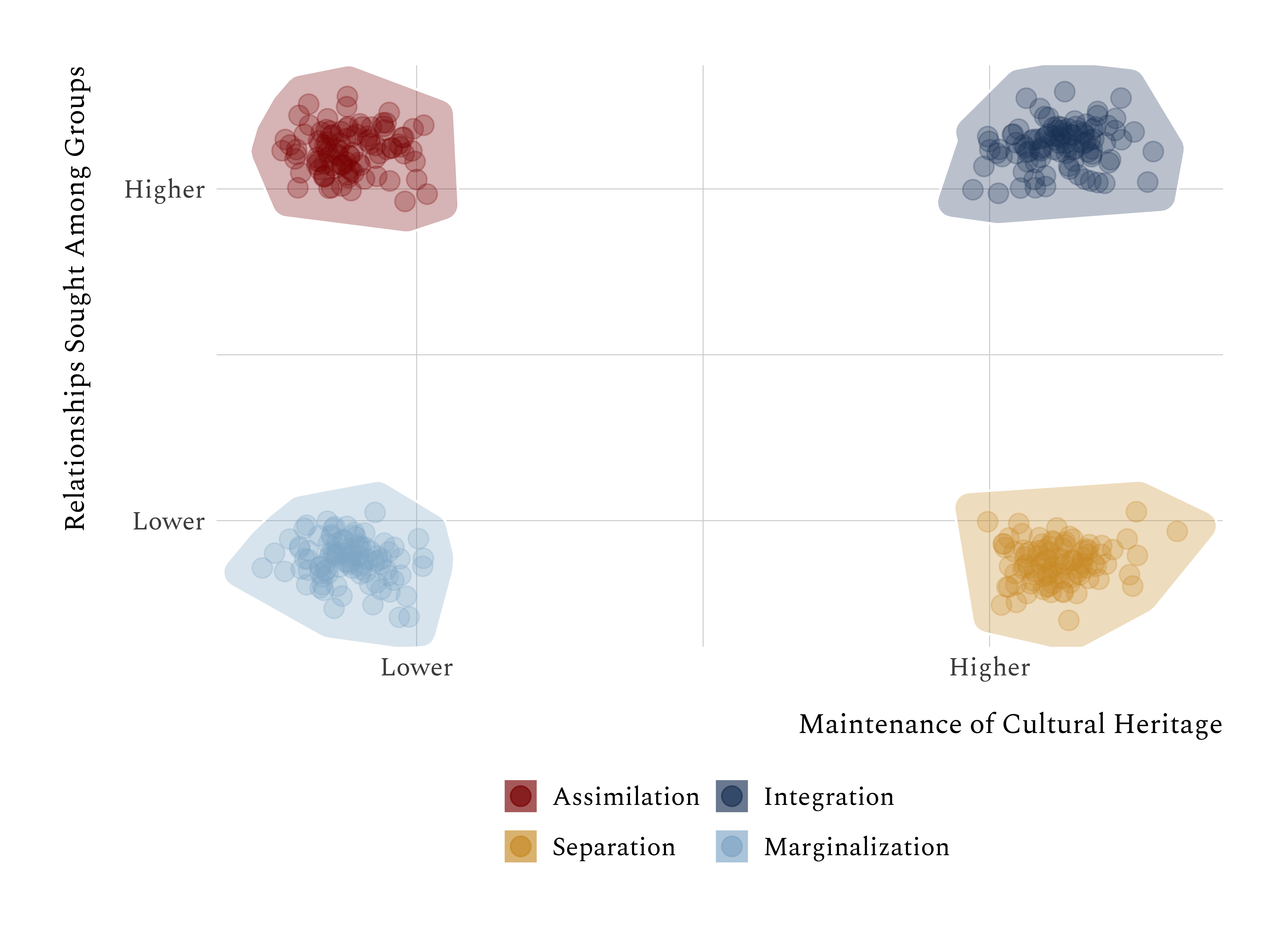
Therefore, John W. Berry—in his original theoretical formulations—identified four major acculturation strategies that individuals deploy in “intercultural encounters” (cf. Berry 2017).
Assimilation
Integration
Separation
Marginalization
From the point of view of nondominant ethnocultural groups, when individuals do not wish to maintain their cultural identity and seek daily interaction with other cultures, the assimilation strategy is defined.
(Berry 2017:23, EMPHASIS ADDED)
When there is an interest in both maintaining one’s original culture and having daily interactions with other groups, integration is the option …. [H]ere, there is some degree of cultural integrity maintained, while at the same time the individual seeks, as a member of an ethnocultural group, to participate as an integral part of the larger society.
(Berry 2017:23, EMPHASIS ADDED)
In contrast, when individuals place a value on holding on to their original culture, and at the same time wish to avoid interaction with others, then the separation alternative is defined.
(Berry 2017:23, EMPHASIS ADDED)
Finally, when there is little possibility of, or interest in, cultural maintenance (often for reasons of enforced cultural loss), and little interest in having relations with others (often for reasons of exclusion or discrimination), then marginalization is defined.
(Berry 2017:23, EMPHASIS ADDED)
Of course, nondominant groups and their individual members do not always have the freedom to choose how they want to engage in intercultural relations and acculturation. Constraints imposed by the dominant group may enforce certain kinds of relations, or limit the choices of nondominant groups or individuals. This is most clearly so in the case of integration, which can only be freely chosen and successfully pursued by nondominant groups when the dominant society is open and inclusive in its orientation toward cultural diversity.
(Berry 2017:23, EMPHASIS ADDED)
In the case of assimilation, there are obvious constraints on whether individuals can “pass” into, and become accepted as a member of, another ethnocultural group. People’s characteristics, such as accent, dress, and physical appearance, will signal their existing group membership, and if these features are not acceptable to members of the other group, they will impede (even prevent) successful assimilation. In such cases, the desire to be assimilated, but being prevented from doing so, may induce acculturative stress.
(Berry 2017:23, EMPHASIS ADDED)
Moreover, integration (and separation) can only be pursued when other members of one’s ethnocultural group share in the wish to maintain the group’s cultural heritage. In this sense, these two strategies are “collectivistic,” whereas assimilation is more “individualistic.”
(Berry 2017:23, EMPHASIS ADDED)
So, how can we systematically think about the social constraints that structure individual-level acculturation strategies?
An adaptation of Table 2.2 in Berry (2017)
Click to Expand Image
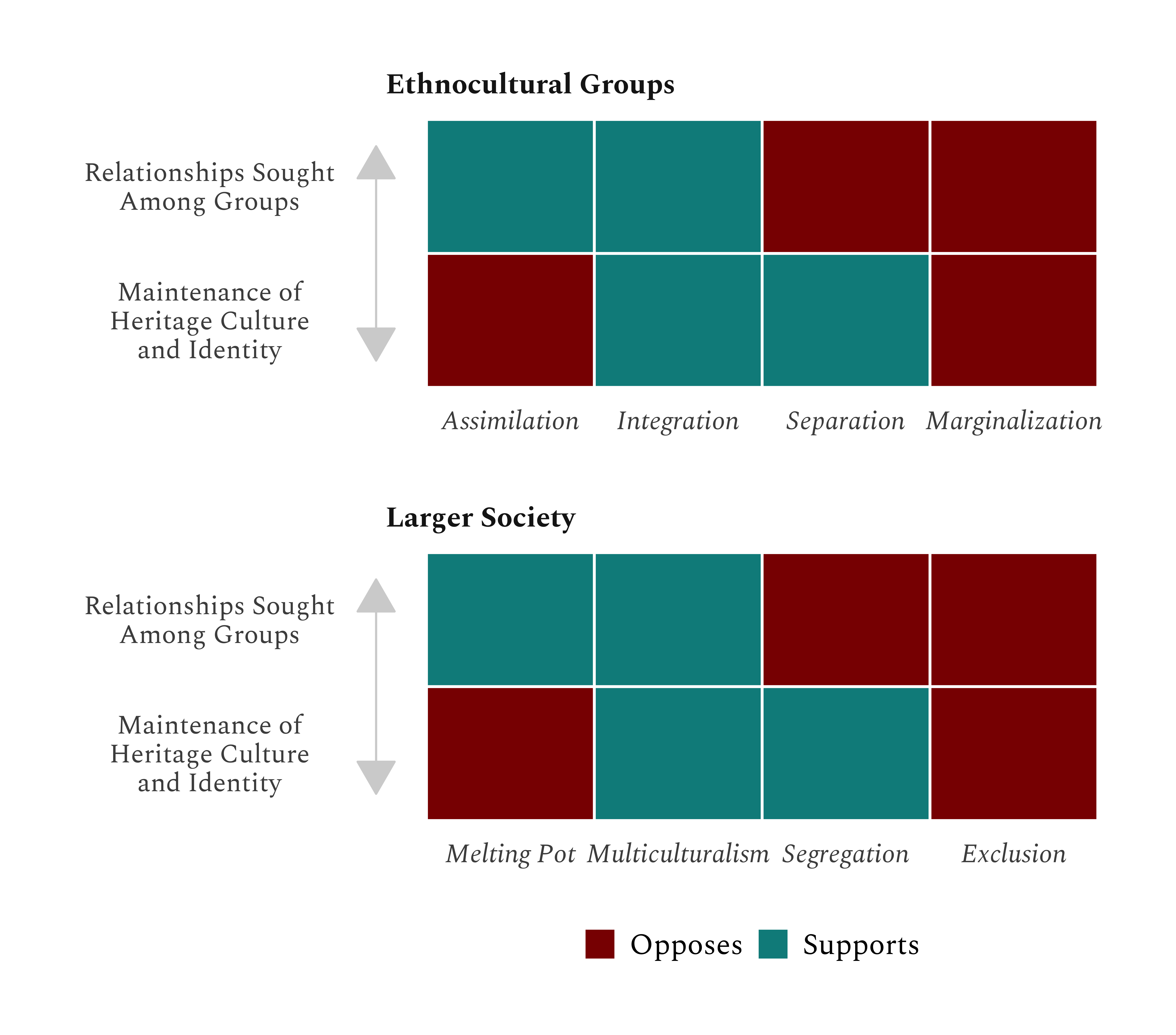
Adaptation of Figure 2.2 in Berry (2017)
Schwartz and colleagues (2010) identify some of the limitations of Berry’s (ideal-typical) typology of acculturation strategies. What are some of the issues they highlight? Moreover, how do they draw on the contexts of reception framework? Discuss in small groups.
Note: Scroll to access the entire bibliography